
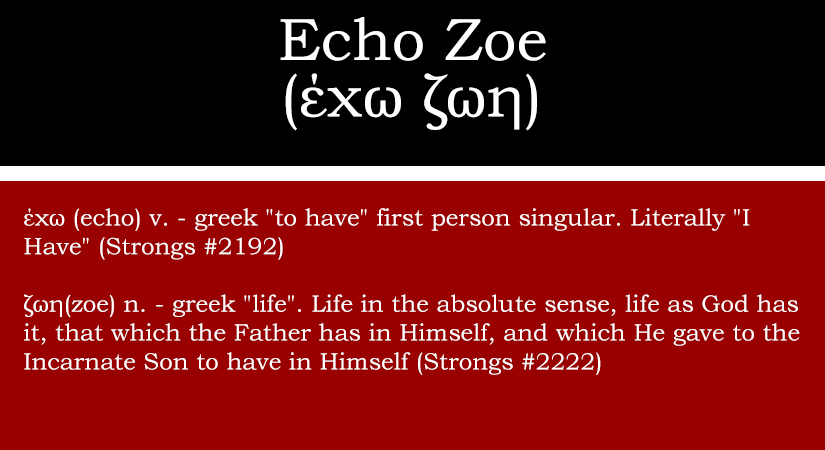





Welcome to έχω ζωη! As έχω ζωη enters into 2010, it continues strong, in it’s seventh year. The έχω ζωη podcast continues to be the main focus, and is doing well. The podcast is nearing completion of it’s second year, and remains greatly enjoyable. Guests and topics vary, from personal friends to heads of national ministries; but all make for a lot of fun, and strive to glorify Jesus Christ and be faithful to the Word of God.

If you have suggestions to improve the podcast, or guest/topic suggestions, please share them with me via the email link in the navigation bar.

I’ve also enjoyed the article series entitled Misapplied Scripture. In each article, I take a look at a Bible verse that is well known to most Evangelical Christians, but very often misused. Several have been addressed, with more to come. Also in progress is a series on Logic & Argumentation entitled Lessons in Logic

Get Email Notifications of New Podcast Episodes

I have an email notification list that will inform those interested of new podcast episodes. If you like the podcast but don’t use RSS or iTunes and would like to know when new episodes are posted, sign up for email notifications here. These emails are also useful if you care to share an episode with friends or family, just forward the email to those you wish to share it with.

February 2010 - Phil Johnson: The Doctrines of Grace
January 2010 - Patrick Szalapski: The Atonement
December 2009 - Eric Douma: John 1:1 & Titus 2:13
Archives
June 9, 2009 - Misapplied Scripture: Matthew 7:1

“Do not judge so that you will not be judged.” – Matthew 7:1 – NASB
While the previous “Misapplied Scripture” articles have dealt with verses that are often used out of context by those professing a faith in Christ, this is a verse that is often used by those who have made no such profession, or [...]

October 11, 2008 - Misapplied Scripture: Philippians 4:13

“I can do all things through Him who strengthens me.” – Philippians 4:13 – NASB
So far in our “Misapplied Scripture” series, we have looked at three verses that are fairly well known in the Church, but often taken out of context. In this article, we tackle a fourth that is popularly used by Christians in [...]

September 14, 2008 - Misapplied Scripture: Matthew 18:20

“For where two or three have gathered together in My name, I am there in their midst.” – Matthew 18:20 – NASB
What a beautiful verse, though so often misunderstood. It is common for Christians to comfort each other with it, implying some mystical presence of the Lord whenever and wherever his people are gathered together [...]

July 9, 2008 - Misapplied Scripture: Jeremiah 29:10

“For I know the plans that I have for you,’ declares the LORD, ‘plans for welfare and not for calamity to give you a future and a hope.” – Jeremiah 29:11 – NASB
Popular among Evangelicals today is the idea of “claiming” a verse for one’s self, latching on to a passage of scripture and [...]

June 7, 2008 - Misapplied Scripture: Revelation 3:20

“Behold, I stand at the door and knock; if anyone hears My voice and opens the door, I will come in to him and will dine with him, and he with Me.” – Revelation 3:20 – NASB
In our previous Misapplied Scripture article, we discussed a verse that is popular among those who teach that [...]

Archives
February 23, 2010

Phil Johnson: The Doctrines of Grace

In this episode, I got a chance to speak with Phil Johnson. Phil is the executive director of Grace to You, the tape and radio ministry that features the teachings of John MacArthur, a member of the Fellowship of Independent Reformed Evangelicals (FIRE), founder and blogger at Pyromaniacs, and curator of The Spurgeon Archive. Phil and I discussed the Doctrines of Grace, specifically the five points of Calvinism.

In the discussion of “Limited Atonement”, Phil referred to a sermon given recently by John MacArthur. That sermon can be found here.

Phil also referred to a lecture he gave called “The Story of Calvinism”, which can be found here, and an essay he wrote about Hyper-Calvinism, which can be found here. At the time this is being posted, his sermon on Philippians 1:6 is not yet posted, but should show up here soon.

To sign up for email notifications of new episodes of Echo Zoe Radio, visit http://www.echozoe.com/archives/2292


February 7, 2010

Lessons in Logic #10: The Bandwagon

The Bandwagon is another logical fallacy that is also a form of propaganda. Someone using the Bandwagon is attempting to win the debate through popularity rather than logic. Anyone who has ever been a child has probably used the Bandwagon.

“Mom, can I go see Terminator: Blood Bath with Jimmy and Bobby?”
“No you cannot, that movie is rated ‘R’, and you are 11.”
“Oh come on Mom, everybody else has already seen it.”

Explaining why he’s mature beyond his years would be a valid argument for why he should be allowed to see the movie, but claiming that “everybody else has already seen it” is a bandwagon fallacy.

“Hey Mike, you should try this, sniff this glue.”
“Ahh, no thanks, I like my brain cells.”
“Everyone’s doing it man, just try it.”

This form of peer pressure is, again, a bandwagon fallacy.

Bandwagon is also used often in advertising.

“Ford F-150 has been the best selling pickup for over 30 years.”
“Choosy Moms choose Jiff”
“More Americans get their news from ABC News than from any other source.”

Next Lesson: Appeal to the People


January 28, 2010

Lessons in Logic #9: Equivocation

A play on words can be humorous, but it can also be a logical fallacy. Equivocation exchanges one definition of a word for another. Take the following examples:

  • It’s wrong for a man to beat his wife. When Mike played his wife Cheryl in a game of chess, he beat her. Therefore, what Mike did was wrong.
  • The Virgin Islands are the only place in the United States that does not drive on the right side of the road. Therefore, they drive on the wrong side of the road in the Virgin Islands.
  • Trains run on tracks. The tail of a wedding dress is called a train. Therefore, wedding dresses run on tracks
  • Banks are places that store money. There is a snow bank at the end of my driveway. Therefore, there is money stored at the end of my driveway.
  • Two wrongs don’t make a right, but three rights make a left.

In each of these cases, two different meanings of a word are used.

Clearly, debates or claims don’t typically contain such obvious cases of equivocation, they are usually more subtle. From about.com:

The sugar industry, for instance, once advertised its product with the claim that “Sugar is an essential component of the body . . . a key material in all sorts of metabolic processes,” neglecting the fact that it is glucose (blood sugar) not ordinary table sugar (sucrose) that is the vital nourishment.

The average person doesn’t know, or doesn’t often think about the fact that there are three kinds of sugar: glucose, sucrose, and fructose. It is easy to be deceived by the above claim of the sugar industry.

Next Lesson: The Bandwagon


January 28, 2010

Tough Questions for Republicans

Over the last couple of years, I have drastically reduced the amount of posts I do on political issues, to the point of doing almost none. This is something I thought was interesting though, and would like to share my thoughts.

The Democrats are licking their wounds after the upset of Scott Brown in Massachusetts. Fortunately for those of us who love Liberty, they seem to be deaf to the message they are being sent. In an effort to try to chip away at Tea Party support for “Republicans”, they’ve devised a list of questions that I suppose they thought would be intimidating. While I am no Republican, and am not running for office (so I’m not one these questions were specifically targeted towards), I thought I’d address them.

*****

Do you believe that Barack Obama is a U.S.citizen?

Short answer: Yes.

Long Answer: This was a poorly crafted question. If you really wanted to draw out the “wing-nuts” (as you see them) the question would be Do you believe that Barack Obama is a Natural Born U.S.citizen? To that I say: Absolutely Not! In my opinion, if the question were such an easy one to settle, it would have been settled during the campaign, or at least before inauguration day. It seems that there are several ways Obama could have proven his place of birth, the easiest being to produce his long-form birth certificate. He has not only refused to do so, he has spent tons of money on lawyers to prevent it from happening.

So do I think there was some conspiracy to get the Honolulu newspapers to print his birth announcement in case he were to run for President over 4 decades later? Don’t be crazy! That is easily explained by the fact that such announcements were done automatically when birth records were created. However, the birth records that triggered the announcement were Hawaii’s “Certification of Live Birth,” not a long-form birth certificate. What’s the difference? The Certification of Live Birth was easy to get, and did not require that a child actually be born in Hawaii. It seems reasonable to speculate that Obama’s mother got a certification of live birth for Barack upon returning to Hawaii after traveling to Kenya in order to make his legal status in the U.S. easier to deal with. There was no conspiracy to create a paper trail for a future President.

The certification of live birth speculation is just interesting, but not even really relevant to the question of Obama’s citizenship status, for many reasons. First of all, the Founders didn’t care about where a child was born, but who a child was born to. Citizenship is passed on from parent to child like any other trait, like eye color. It is natural that if parents are citizens, then child is too. That’s where things get sticky for Obama. His mother was a citizen. However, his father was not. He was a citizen of the United Kingdom. He was from Kenya, which was an English colony at the time of Obama’s birth. Also, under Hawaiian law at the time, the parents had to be at least 18 years old to transfer citizenship to their children automatically. Obama’s mother was 16.

The strongest case for Obama’s citizenship status hasn’t even been made yet. Even if he was born in Hawaii to two citizens (there is no question his father was not, but just for the sake of argument we’ll disregard that), and was a natural-born citizen as the Founders intended, he still has another problem. There are two pieces of evidence that strongly suggest that at some point in his youth, he was not a citizen. The first is his schooling in Indonesia. In order to be enrolled in the schools in Indonesia, he had to be an Indonesian citizen. Indonesia did not allow dual-citizenship, so if he was an Indonesian citizen, he was not an American citizen. Second, Obama admits to travelling to Pakistan in the 70’s. At the time that he says he went there, Pakistan did not allow American citizens into their country. So either he lied about not being a citizen to get into Pakistan, or he lied about going to Pakistan.

The point to showing that at one time he appears to not have been a U.S. citizen is this: even if he was born here, his citizenship would have had to have been renounced. That means that if he is a citizen now (which I have no reason to doubt, he probably is), he would be a naturalized citizen, not natural-born. It is possible to be born a citizen, renounce your citizenship (or have it renounced on your behalf by a legal guardian), and then regain your citizenship later, but then your citizenship status rests on your most recent acquisition of citizenship, the naturalization.

Unfortunately, those with the power to investigate this and do something about it have made it clear that they have no desire to do so. Obama will leave office when his term (be it first or second) is up, not because of his citizenship status.

*****

Do you think the Tenth Amendment bars Congress from issuing regulations like minimum healthcare coverage standards?

Short answer: Yes.

Long Answer: This is a ridiculously stupid question. The only reason it wouldn’t is if you don’t believe it means what it says, or doesn’t matter what it says.

The powers not delegated to the United States by the Constitution, nor prohibited by it to the States, are reserved to the States respectively, or to the people.

It’s been a while (like months) since I actually read through the Constitution, but I don’t remember there being anything in there about health care. I just did a search through the text and didn’t find it either, so I feel confident in my memory of the text. The tenth amendment makes it pretty clear that such issue should be dealt with at the state level. Massachusetts did so under Romney, and though I disagree I am not a resident of Massachusetts, have no obligation to their law, but wish them well with it. I think it’s wonderful that states can chose to do things like this on their own as they wish.

*****

Do you think programs like Social Security and Medicare represent socialism, and should never have been created in the first place?

Short answer: Yes.

Long Answer: They were created under FDR, not George Washington, so they clearly weren’t on the minds of the Founding Fathers. It was Karl Marx, Godfather of socialism, that said “from each according to his ability to each according to his need.” Socialism is the transfer of wealth from one class of people to another. Social Security and Medicare work because they tax working people and give to retirees and the disabled.

Besides, the very name is Social Security. Kind of hard to get around it.

As for …and should never have been created in the first place? Not at the Federal level. See the previous question on the 10th amendment, it’s the same thing. If I were in charge, Social Security and Medicare would be phased out over a period of about 10-20 years and either privatized or transferred to the states, or both.

Call me crazy, but I am a Libertarian. Forcing people to pay into a ponzi scheme isn’t exactly conducive to Liberty, and there is a reason that ponzi schemes are illegal when private citizens create them. It should be illegal for the government to create them too (and I believe that the Constitution bans them by not explicitly delegating the power to create them.

Being ponzi schemes, it’s no shock that they are running out of money and scheduled to become insolvent in the near future. It’s time to end them before they end us.

*****

Do you think President Obama is a socialist?

Short answer: Yes.

Long Answer: He calls himself a “Progressive”, but I see no difference. The progressive movement has always had the same goals as those who openly call themselves Socialists. Some people call it a sofa, I call it a couch, but either way it’s a piece of furniture.

Besides, while he likes to mock people who use the word “socialist”, he openly embraces socialist policies from beginning to end.

*****

Do you think America should return to a gold standard?

Short answer: Yes.

Long Answer: There’s a reason that the term “gold standard” carries the meaning that it does. If someone says that X is “the gold standard” of A, they’re saying it’s the ideal. In 5,000 years of recorded history, there have been many different monetary systems tried, but gold has always been the most stable. The Byzantines alone made it work for over 800 years!

The system we have now of fiat currency is failing after only less than a century. The dollar has lost nearly 95% of its value since the creation of the Federal Reserve, and had to be decoupled with gold by Nixon in 1974 because the discrepancy between the values of the dollar and gold reached a breaking point.

Fiat currencies are loved by governments, especially socialist ones, because it allows them to spend money that doesn’t exist. In order to pay for expensive social programs, a government has three choices:

  1. Tax the people to raise the money.
  2. Borrow the money.
  3. Print new money.

The first option is only popular to a point. People prefer taxes they can afford to borrowing against their future. It is always better to pay for what you consume when you consume it, rather than putting the bill off for a future date. However, we cannot afford everything we are consuming, so taxes are insufficient.

That pushes us to our second option. The people will tolerate a level of borrowing, but not much. Also, they will tolerate borrowing when it makes sense. For example, paying for roads with a gas tax makes sense, because that leads to the roads being paid for by the people that use them. Gas taxes are often not enough to pay for a new road at the time of construction though. It is reasonable to borrow the cost of the road and pay for it over the life of that road. Roads don’t need to be built every day, month, or year. They are often built to last as much as 50 years. It’s reasonable to spread the cost over several years, even a decade or two. But people will generally not tolerate borrowing money that is spent on something that is immediately consumed and lost. That is an unsustainable practice. If an individual is borrowing money to pay for basic necessities like food, or fuel, that is consumed and then gone long before the bill comes due, they will quickly be over their head in debt. Governments are no different.

The favorite option of governments is number three. They can print the money they need. That causes inflation, since the supply of money increases when more is printed. They know the effects of inflation won’t be seen until long after the newly printed money is spent, so government feels the effects of inflation much less than the people. It is a hidden tax though, and it effects those at the bottom of the economic ladder the hardest. Printing new dollars means that every dollar out there is worth less. The government gets to take the value of your money from you, without actually touching the money you have. People will tolerate this to a point, and the government can easily put up scapegoats to take the blame for their actions. They’ll just blame big business for rising prices. Most people don’t understand the real cause of inflation, and let them get away with the scapegoating.

The gold standard forces the government into fiscal responsibility. It takes option three away from them. Also, stability leads to prosperity. When people can reasonably assume what the future holds, they will conduct business. When they don’t know what tomorrow holds, they are reluctant to take the risks that business requires. If the dollar will be worth less tomorrow than it is worth today, people will shift their risks to account for that, but that shift will always consume resources and reduce prosperity.

Besides all that, getting off the gold standard has only increased the problems that it was supposed to solve.

*****

There you go, not so intimidating if you ask me. I am actually somewhat glad these questions are out there, as I think Republicans, Conservatives, and Libertarians should not be afraid to answer them. If someone is, he is probably more interested in power than political solutions to real problems, and wouldn’t be considered for my vote.


January 25, 2010

Lessons in Logic #8: Appeal to Pity

Also known as Argumentum ad Misericordiam, the Appeal to Pity is a form of Red Herring argument in which logic is abandoned in favor of an emotional response, specifically pity. Because the Appeal to Pity is manipulative in nature, it also falls under the umbrella of propaganda.

Mr. Vandalay: Thanks for coming in to day Mr. Costanza. Let me ask you, why should Vandalay Industries hire you to be our latex salesman?
Mr. Costanza: My unemployment benefits are about to run out, and if I don’t get this job I will lose my apartment.

The nature of Mr. Costanza’s unemployment benefits are inconsequential to Vandalay Industries, and have no bearing on whether or not he’d be an effective salesman for them. Mr. Costanza is appealing to their sense of pity in an effort to get the job.

Like any propaganda technique, the Appeal to Pity is often used in both advertising and politics.

In advertising:

Each year, millions of children starve in third-world countries, won’t you give just 75 cents a day to provide food to these children, kids like little Miguel here, who eats grass and crickets just to survive.

In politics:

It is my life’s goal to get Universal Health Care passed in the United States. To help people like Sherry Bobbins of Little Rock, Arkansas. She is 73 years old, a widow with 12 children and 58 grandchildren. Her husband died two years ago of a brain tumor. He couldn’t get treatment because he had no health insurance, he couldn’t afford the high premiums while living on only Social Security and the meager winnings he could get by playing pull-tabs. Now Sherry is maimed with a broken hip, she can’t lift her little grandchildren, who just want hugs from their grandmother. Like her husband, she has no health insurance. Despite the fact that her children are working hard, some of them taking three jobs, to pitch in and help her, the insurance companies won’t give her a policy because of her pre-existing conditions. In addition to the broken hip, she has leukemia, kidney stones, cataracts, osteoporosis, congenital heart failure, and halitosis. We need this bill to improve the lives of people like Sherry Bobbins!

Sometimes, a perfectly logical argument will result in a sense of pity. If pity is not the aim, no fallacy is committed. For example:

Jack: Steve, I’m afraid I’m going to have to fire you for not showing up to work yesterday, and getting here a half hour late this morning.
Steve: I’m sorry that I didn’t make it in. I was on my way to work when I got into an accident with an ice cream truck. I broke my left leg and was knocked unconscious. I woke up at 8:00PM, three hours after the office closed, in a hospital bed. The doctors patched me up and made sure there was no more damage, before discharging me around midnight. Having no car, I took the first bus I could get this morning to come into work, it had a flat tire and took an hour for the bus company to get another bus to us.
Jack: Steve, that’s terrible. I’m sorry you had to go through that. I’ll talk to the owner, but I am pretty sure I can talk him into letting you keep your job.

Steve’s story probably invokes a sense of pity upon Jack, but that is secondary to the reasons given why he missed work yesterday and was late today.

Next Lesson: Equivocation


January 23, 2010

Lessons in Logic #7: Post Hoc Ergo Propter Hoc

The Post Hoc Ergo Propter Hoc fallacy is also known as “After this, therefore because of this”. It’s a very common fallacy, easy to commit, and often difficult to detect. It’s based on the assumption that if A happens after B, A was caused by B.

This is the fallacy that starts superstitions. When a baseball pitcher puts on green socks with orange stripes before a game and goes on to pitch a no-hitter, it’s easy to see why he credits the socks with giving him “good luck”. If he doesn’t wear the socks in his next game and plays horribly, it often reinforces the superstition. The pitcher falls into the Post Hoc Ergo Propter Hoc fallacy.

Like the previous fallacies we looked at, this is another one that is common in politics. For example, gun-control advocates will pass a law banning guns in a city, then violent crime involving guns goes down the next year. They assume that the law cause gun crime to go down. Likewise, gun-rights advocates may get a bill passed requiring law enforcement to issue concealed-carry permits to anyone who receives training and passes a background check. Shortly after the bill passes, gun crime goes down, and the advocates of “shall issue” laws point out that the increased numbers of law-abiding citizens carrying deadly weapons for defensive purposes caused criminals to think twice before committing violent crime, which caused the crime statistics to go down.

This fallacy is particularly tricky because sometimes ‘A’ really does cause ‘B’. An obvious example would be that when the temperature rising after sunrise. In many places, especially desert climates, the sun rising really does cause an increase in temperature. The “Scientific Method” depends on the law of causation, and the reliability of experimentation to be reproducible. ‘A’ must consistently be followed by ‘B’, or the scientific method falls apart. This fallacy merely shows that ‘B’ following ‘A’ doesn’t necessarily mean there is causation. Sometimes there are unseen factors involved that are the real cause. Perhaps every time you observe ‘A’, ‘C’ happens as well, and is the real cause of ‘B’. ‘A’ happening before ‘B’ just happens to be a coincidence.

Next Lesson: Appeal to Pity


January 23, 2010

Patrick Szalapski: The Atonement

For this episode, Patrick Szalapski of ShareYourFaith.org returns for a second episode with me to discuss the doctrine of Penal Substitutionary Atonement. We also discussed some of the competing doctrines, such as Christus Victor.

To sign up for email notifications of new episodes of Echo Zoe Radio, visit http://www.echozoe.com/archives/2292


January 21, 2010

Lessons in Logic #6: Appeal to Authority

If you’re categorizing fallacies as sub-fallacies of others, the Appeal to Authority would be a sub-fallacy of the Genetic Fallacy. It is used when experts are cited that are not experts in the subject at hand.

Curt: Warren Buffet is the richest man in the world, and he says that Vitamin-D3 supplements reduce your chances of getting cancer.
Michelle: I’ve never heard that before, but Warren Buffet is obviously a savvy guy, so I guess that’s not so hard to believe.

Curt is appealing to Warren Buffet on a matter of nutrition, when Buffet’s expertise is in business and finance. This is a faulty Appeal to Authority.

This fallacy is very common. People appeal to movie stars, politicians, and know-it-all uncles all the time. Appealing to a movie star in an argument about the best technique for remembering ones lines in an Off-Broadway play would be a legitimate appeal to authority, because they clearly have experience to know what they are talking about. Appealing to them to argue the best way to reduce deer overpopulation in Wisconsin lake country would be fallacious. They are welcome to their opinion, as is anyone, but they probably don’t have experience with deer populations, and so they lack expertise.

Next Lesson: Post Hoc Ergo Propter Hoc


January 20, 2010

Lessons in Logic #5: The Genetic Fallacy

The Genetic Fallacy is one in which an argument is supported or dismissed based on its origin, rather than its merit. It is similar to the Ad Hominem attack, and can even be easily confused with Ad Hominem, but rather than attacking the person making the argument, the source is attacked.

Here’s an example to explain the difference:

Tim: I heard on the radio that France’s Universal Healthcare System is misleading. Everyone has insurance through the government, but 90% of French people also have private insurance to supplement the shortcomings of their government system. What’s the point of paying high taxes so everyone can have health insurance if that insurance doesn’t cover what people actually need?
Susan: That was Glenn Beck who said that, you can’t believe what he says because he’s a right-wing conspiracy theorist nut-job.

This is an example of the Genetic Fallacy because Glenn Beck is the source, not Tim. Had Susan dismissed Tim as a right-wing conspiracy theorist nut-job, it would have been an Ad Hominem. Susan is committing the Genetic Fallacy because the nature of Glenn Beck’s political views, belief in conspiracy theories, and state of mental health have nothing to do with whether or not French people need supplementary health insurance. Likewise, had Susan embraced Tim’s argument based on having a celebrity-crush on Glenn Beck, she would have also been committing the Genetic Fallacy.

Next Lesson: Appeal to Authority


January 8, 2010

Lessons in Logic #4: Tu Quoque

Tu Quoque is a form of ad hominem. It means “You too”. It’s often called “The You Too Fallacy”.

The way Tu Quoque works is that a person’s argument is dismissed because he is guilty of violating his own argument. He is hung on his inconsistency.

Dave: Marriage is a sacred institution Brian, you need to take it seriously and work hard to keep your marriage healthy. Cheating on your wife is the most destructive thing you can do to your family and your marriage.
Brian: What do you know about marriage and cheating? Your first two marriages ended when you were caught cheating.

Brian dismisses Dave because he was guilty of that which he is trying to persuade him to stop doing. Not only does this avoid the argument about how to preserve a marriage, it dismisses the fact that Dave is trying to stop Brian from making the same mistakes. Teenagers are famous for using Tu Quoque arguments against their parents.

In politics, Tu Quoque often shows up as “flip-flopping”. For example, John Kerry supported the war in Iraq before he opposed it. His original support for the war does not disqualify his latter opposition, however his reasons for that opposition may provide reason to dismiss his opinion. Likewise John McCain favored amnesty for illegal aliens in 2000, but opposed it in 2008. While his change of opinion could be chalked up to political expediency, dismissing him on the grounds of a change of mind would be logically fallacious.

Another Tu Quoque political argument is common among non-politicians.

Rick: “I can’t support Democrats because I am disgusted by all of the corruption they have been involved in. The governor of Illinois tried to sell Obama’s senate seat to the highest bidder. Tim Geitner and Charlie Rangel cheated on their taxes, and several Senators had their votes bought in the Health Care bill, like Nelson of Nebraska and Landrieu of Louisiana.”
Tom: Maybe they got caught, but all politicians do it.

One corrupt politician doesn’t excuse another’s corruption. Tom is avoiding the issue.

Arguments must be addressed on their own merit, and Tu Quoque is just another way of avoiding the merits to shift the discussion.

Next Lesson: The Genetic Fallacy


© 2010 έχω ζωη (Echo Zoe) | Blog Entries (RSS) | Comments (RSS)